My First Wacky Quacky Duck Derby

June 21, 2023

My First Wacky Quacky Duck Derby

The 2023 United Way of Wayne and Holmes Counties (UWWH) Wacky Quacky Duck Derby was the first time I had ever heard of a “Duck Derby.” Having the opportunity to participate in it, I was not disappointed. Most people don’t see how much work and effort goes into putting together a rubber duck race that takes about 10 minutes.


The first part is getting the word out and designing flyers, emails, and social media posts to inform the world of our fabulous event. After you prepare the materials and create the back end so people can adopt ducks online, you must find ways to share the information. The communication portion of the event is the longest, as this goes on for a couple of months before the ducks take a swim.


The week of the event is a flurry of activity. Each duck must be sorted and accounted for to be sure all the numbers are there. This year, there were nearly 1,000. Ducks were everywhere; in our conference room, on the floor, on tables, and on chairs. It reminded me of a ball pit, except it was ducks.


On the day of the event, it’s all hands-on deck. As we ensure we have everything we need, we are still taking last-minute duck adoptions and ensuring those ducks make it to the stream. The City of Wooster was a big help and donated snow fences and stakes, which I found out later are critical to retrieving the plastic racers.


Since the race’s inception, we have been fortunate to have an anonymous donor volunteer their property as the place to hold the event. The venue is perfect for duck racing. There is a lovely bridge overlooking a beautiful stream in the countryside.


Thankfully, a few volunteers were Derby veterans and knew exactly what needed to be done. A few of us carried the boxes of ducks up to the top of the bridge while the others walked downstream to set up the snow fence and finish line. Many hands make light work, and we were prepared to start racing about 15 minutes after arriving.


There was much concern about the water level in the stream. The rain was not seen in a few weeks, and the stream was low. The ducks were up to the challenge as the sponsorship ducks were released for their race. Two sponsor ducks made an early commanding lead and finished in the first two places. I was in the position to be the official duck catcher as I caught several ducks in the order of finish and thought catching them was easy. Congratulations to Park National Banks duck “Pork,” who won the sponsor race and was presented with a trophy.


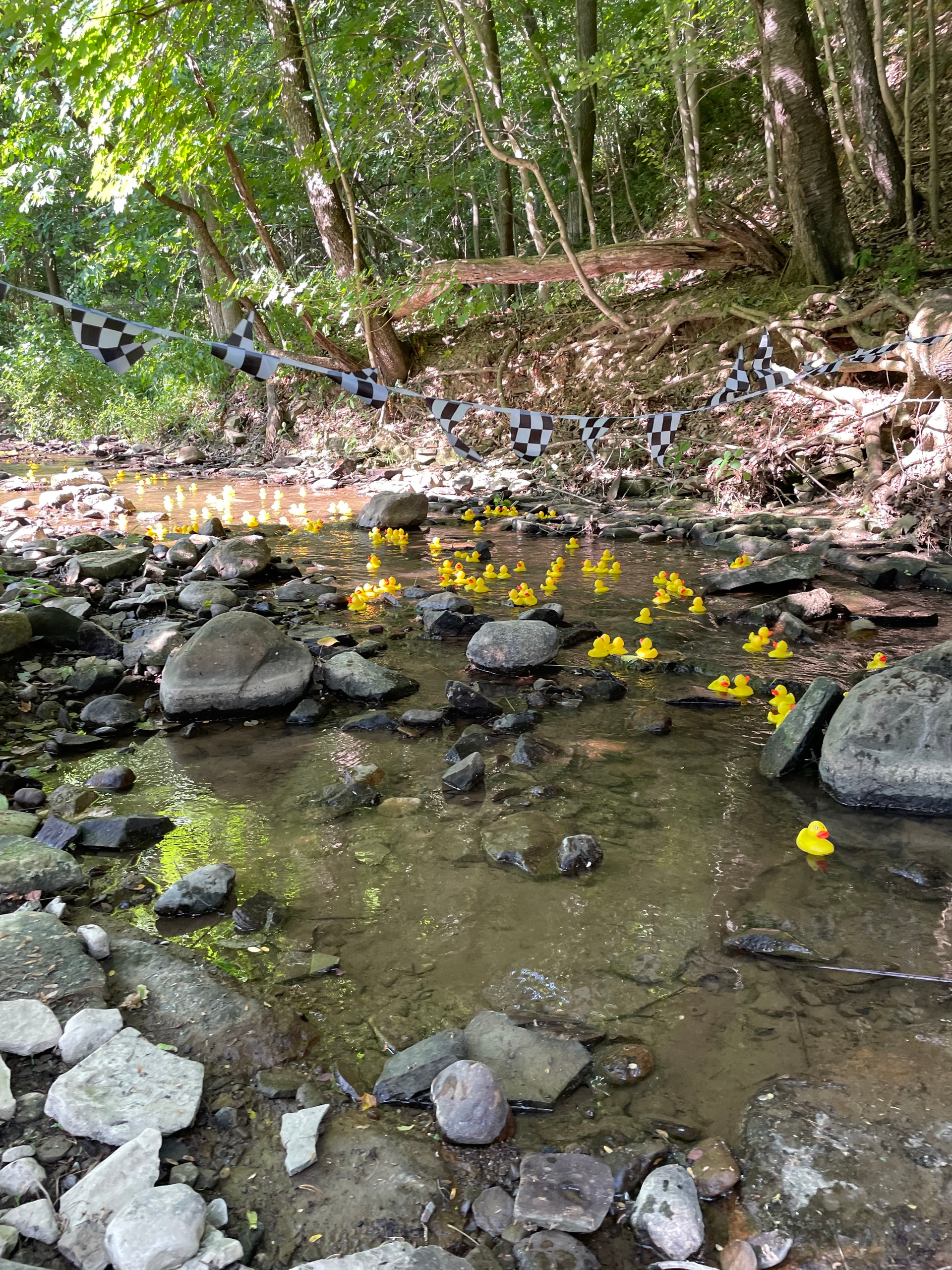
Nothing could have prepared me for what followed. A deluge of nearly 1,000 ducks was thrown into the stream from the top of the bridge. The whole stream immediately in front of the bridge was solid yellow with the ducks. I previously googled pictures of duck derbies and knew what I was in for, but the pictures don’t do it justice.


Before I knew it, the first couple of ducks were already at the finish line, and I scrambled to pick them out of the water and keep them in the order they arrived. It was exciting to see them battle for position and bounce around the obstacles in the low stream for a few minutes of the race. All the preparation and plans had been executed to completion.


Everyone pitched in, catching the ducks, and pulling them from the stream. Even though we had installed the snow fence, a few of them found a way to sneak through and make a run for it. Thankfully we were prepared with muck boots and chased them down. We loaded the ducks, pulled up the snow fencing and stakes, and returned to the office.


UWWH was fortunate to have another donor offer their dishwasher for cleaning the ducks. A process that can take a whole day was shortened to under an hour. Once everything was put back in its place, I reflected and was amazed at how much work it takes to have an event that takes such a short time.


I realized that the effort is a testament to the ingenuity and commitment of the UWWH staff to raise funds for our community. That “whatever it takes” attitude that everyone has reflects the dedication the staff has to this mission. Whether it’s a massive event like the Heart & Ghoul with over 1000 participants or a short virtual race, everyone puts all their efforts into success. We raised $9,376.00 with 975 ducks adopted and had some fun in the process. It reminds me of a quote from Henry Ford, “If everyone is moving forward together, then success takes care of itself.”
By Ashley Hershberger July 6, 2026
Feeding Our Future: Knights United By: Ashley Hershberger One of the things I love most about our community is that when we see a need, we don't spend much time asking whose responsibility it is. We ask, "How can we help?" That's exactly how Feeding Our Future came to be. Over the past several months, we’ve been meeting with school leaders, teachers, food pantry staff, pastors, community partners, and community members and working together to answer a simple question: How do we make sure students have access to food when school isn't in session? Beginning October 2, 2026, West Holmes Local Schools will launch Feeding Our Future in partnership with United Way Wayne and Holmes Counties, the Love Center Food Pantry, and the Akron-Canton Regional Foodbank. Here's what that looks like: Elementary students who enroll will receive take-home food bags every other Friday and before school breaks. The bags will include easy-to-prepare foods like cereal, oatmeal, soup, fruit cups, granola bars, and other kid-friendly items to help fill the gap when school meals aren't available. Middle and high school students will have access to school-based pantries where they can pick up snacks, breakfast items, weekend food, and other essentials as needed. The food bags will be assembled at West Holmes High School by volunteers from across our community. Most importantly, there are no income qualifications . Families can participate whenever support is needed and for as long as it is helpful. Because the truth is that life happens. An unexpected bill, a medical expense, changing work schedules, rising costs, or simply a difficult season can impact any family. This program exists to provide support, not judgment. Working Together This program builds on a long tradition of caring for one another in West Holmes. It's not replacing efforts like Share-A-Christmas or the work that schools, churches, food pantries, and community groups have been doing for years. It's strengthening those efforts and creating another way to support students and families. People like Natalie Eichelberger, Mindi Campbell, Bob Porter, Brandi Smith, Andrea Povick, and many others have been doing this work for years. Through backpack programs, food drives, and countless acts of kindness, they've helped make sure students and families had support when they needed it most. Feeding Our Future exists because of that foundation . As someone who grew up here, that means a lot to me. My grandma, Pat, fed generations of students as a cook at Nashville Elementary, and many members of my family have served in the district as teachers and coaches. Through them, I've learned that schools are about more than academics and athletics… they're about taking care of our people. That's exactly what this partnership is designed to do. Each organization brings something valuable to the table: West Holmes Local Schools will coordinate the program, enroll families, host pantry spaces, manage volunteers and organize packing and distribution of food. United Way Wayne and Holmes Counties will bring local partners together, raise funds, pay bills and help ensure the program remains sustainable. The Love Center Food Pantry will help source food and stretch every donated dollar as far as possible. The Akron-Canton Regional Foodbank will connect resources and provide access to food at reduced costs. A special thank you to Kiana Leppla, Dawn Martin, and Katie Schwartz , whose vision and leadership helped move this idea from conversation to reality. Thank you to Greg Long and the Akron-Canton Regional Foodbank for helping connect the right people and resources. And a big thank you to Lisa Walker at TUFF Bags and the team at United Way of Tuscarawas County . Their willingness to share their experience, answer questions, and help another community build something similar has been incredible. Because of their generosity, we're able to learn from a program that is already making a difference for thousands of students in T-County. That's what I love most about this story. Communities helping communities. Neighbors helping neighbors. How YOU Can Help One of the things that makes Feeding Our Future special is that it belongs to the community. And community support will be what keeps Feeding Our Future going. The food in these bags and pantries doesn't appear on its own. It takes volunteers, partnerships, and financial support from people who believe every child deserves the opportunity to learn, grow, and thrive. Because of our partnerships, every dollar goes further than it would at a grocery store. In fact, just $26.50 can provide weekend food for one child for an entire school year. Think about that. For the cost of a family dinner out, a child can have food support every weekend throughout the school year. That's more than food. That's peace of mind for a parent. That's one less worry for a family. That's a student who can focus on learning, playing ball, performing in a concert, hanging out with friends, and simply being a kid. That's hope. At its heart, Feeding Our Future is about food, but it's also about making sure every child knows they matter and every family knows they are supported. When a student opens a backpack on a Saturday morning, I hope they find more than food. I hope they find a reminder that an entire community believes in them. Whether you'd like to donate, sponsor, volunteer, or learn more, please visit: www.uwwh.org/feedingourfuture Questions? Please feel free to reach out to me at (330) 231-4335 or email ashley@uwwh.org . Together, we're not just filling bags. We're building hope, strengthening families, and showing our children what it means to live in a community that cares. United, We Help.
By Kayley Cox June 2, 2026
Give With Confidence: How United Way Protects Every Dollar Part of our process at United Way Wayne and Holmes with grant application management is to verify that all nonprofits or organizations applying for funding are in good standing. And part of that process is doing your research and due diligence. “Good standing” can be subjective, so we have a standard criteria that we follow, for organizations applying for funding. We verify that each organization must be: - “In Compliance” with the Ohio Attorney General - “Active” with the Ohio Secretary of State - Ranked on third party watch sites, Candid and Charity Navigator. Why is this important you ask?? During my first year of managing grants at UWWH, we had a local organization apply for funding. I did my due diligence, looking up their information on each of the above sites. The first red flag: the organization was NOT in compliance with the Ohio Attorney General. We get it, it happens, maybe there is a staffing change and the new manager of this information wasn’t passed the memo. BUT there were additional red flags. The second red flag: the organization name that was applying for funding did NOT match their Employer Identification Number (EIN) that was legally filed. This can happen when an organization changes their name, but they would still have to register as a “DBA” (Doing Business As). It is my job to make sure I’m looking into this. The third red flag and biggest red flag: the organization was applying for funding for transportation... and after digging deeper into the organization, I found out that this organization was breeding dogs and delivering them to people who purchased them as a fundraiser for the “organization.” I know, I know. Sounds crazy, but this is a TRUE STORY. We do not fund puppy delivery. THIS is why it is important for us to trust but verify. THIS is also why we encourage people to donate to United Way. We are verifying and vetting this information, so you can be sure the Wayne and Holmes County organizations we fund are doing the work they say, both efficiently and effectively. And if something doesn’t feel quite right, we check it out. By law (Ohio Charitable Trust Act and the Ohio Charitable Organizations Act), nonprofits must be registered with the Ohio Attorney General . The OAG is responsible for protecting charitable assets and donors. Annual registration State/Annual report must be submitted to keep “In Compliance” with the OAG. The Ohio Secretary of State is responsible for a nonprofit’s legal existence as a corporation, keeping information on the nonprofit’s legal name, statutory agent, & whether the organization is “Active” or dissolved. If a nonprofit becomes inactive or is canceled by the state, it can: - Lose eligibility for grants - Lose tax exemptions - Be unable to enter contracts or operate legally Rankings on third party watch sites provide additional resources that help verify each organization’s information. Candid collects and verifies data on U.S. nonprofits using IRS records (Form 990, 990‑EZ, 990‑PF), Federal and state compliance data, and direct reporting from nonprofits themselves. Candid shows whether a nonprofit: - Is currently recognized by the IRS as tax‑exempt - Has had its status revoked or reinstated - Eligibility to receive tax‑deductible donations Charity Navigator is another resource we use to verify information because it: - Helps as an additional financial screening and identifies governance red flags - Compares charities within the same cause area - Assesses accountability and transparency practices - Has information in one spot that helps makes quick, informed giving decisions Stories like this are exactly why our vetting process matters. It protects donors. It protects the community. And most importantly, it ensures that resources go to organizations in Holmes and Wayne Counties doing the work they promise to do.  When you give to United Way Wayne and Holmes, you can give with confidence. Join us in supporting programs that are accountable, transparent, and changing lives right here at home. Text WEHELP To 44-321 or go to https://secure.givelively.org/donate/united-way-of-wayne-and-holmes-counties-inc
By Katie Koglman May 5, 2026
One Flat Tire Away: The Reality for Working Families in Our Community By: Ashley Hershberger Around Holmes and Wayne Counties, people are doing what they’re supposed to do. They’re working. They’re showing up. They’re trying to get ahead. And still, far too many of our friends and neighbors are one flat tire, one home repair, or one unexpected bill away from falling behind . At United Way Wayne and Holmes Counties, we hear this story all the time… from families, employers, school staff, churches, and local businesses. The problem isn’t effort. It’s that when something goes wrong, there’s just not much wiggle room. Who Is ALICE? You might hear our team talk about ALICE . It sounds like data, but it’s really the people we know: coworkers, parents from ball practice, folks sitting next to us at church and our own family members. ALICE stands for Asset Limited, Income Constrained, Employed . In plain terms: people who are working, but still can’t quite afford the basics. That includes things like housing, food, transportation, childcare, and healthcare. Here’s what that looks like in our community: Holmes County 31% of households are ALICE 9% live in poverty Wayne County 26% of households are ALICE 11% live in poverty That means 40% of households in Holmes County and 37% in Wayne County are living at or below the basic cost of living . These families aren’t avoiding work. Many are working full‑time, sometimes multiple jobs, and still making tough choices: Fix the car or pay the electric bill Buy groceries or fill a prescription Pay for childcare or turn down a better job That’s not bad decision‑making. That’s a math problem. What Household Survival Budgets Tell Us United Way uses Household Survival Budgets to understand what it actually costs to live. Not get ahead, not save… just cover the basics. When you add it all up (rent/mortgage, utilities, food, childcare, gas, healthcare, and taxes) a lot of working families simply don’t earn enough to keep up. Wages haven’t kept pace with real life costs, especially in areas like ours where getting to work often means getting in a car that you yourself are responsible for. That’s why so many hardworking people fall into the ALICE category, even while doing everything “right.” (See example budgets below)
Show More